
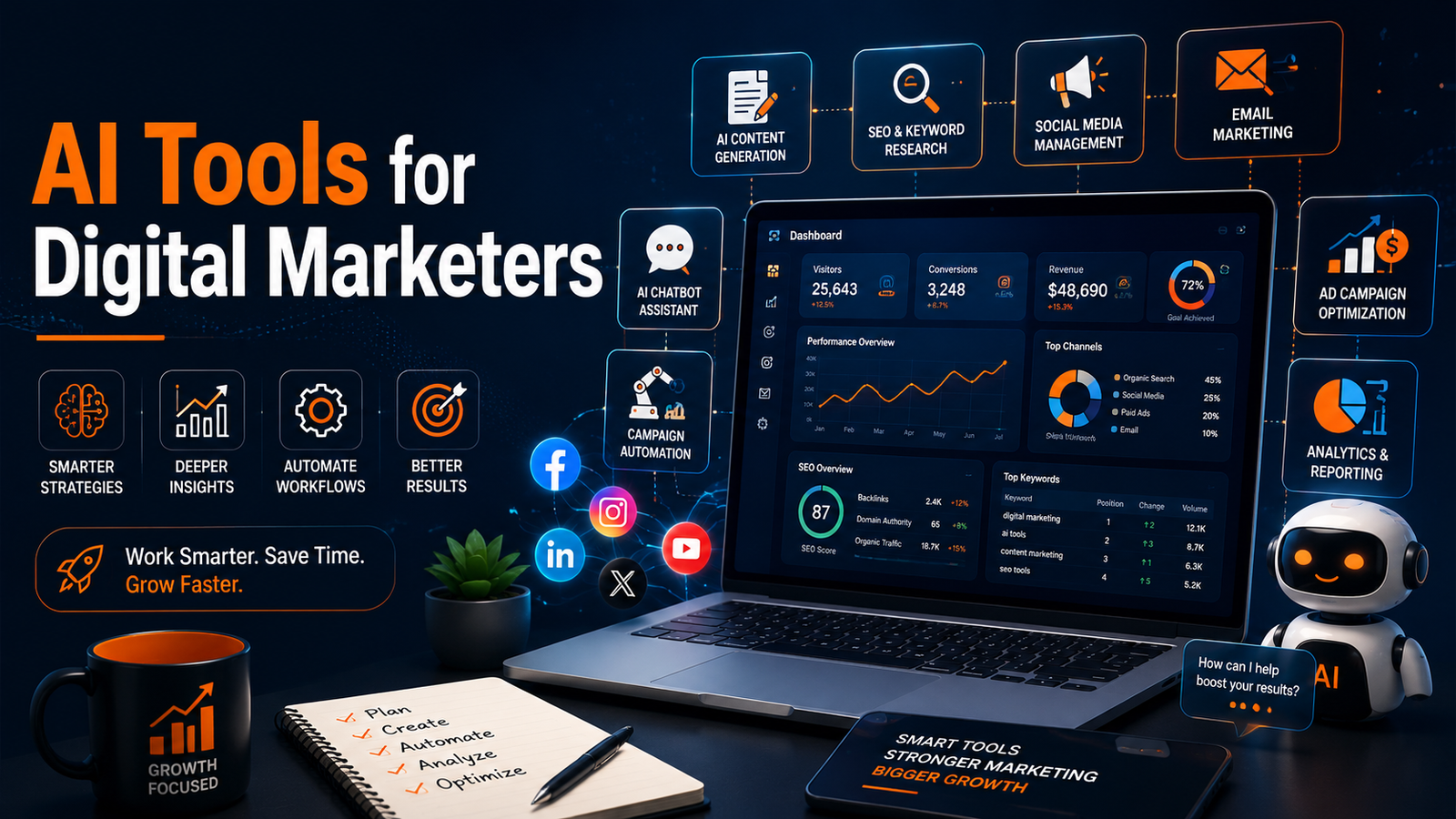
Discover practical AI tools that help digital marketers improve content, advertising, SEO, design, analytics, and productivity.
Digital marketing has always involved a long list of responsibilities. One moment, you are researching keywords. The next, you are writing an advertisement, reviewing campaign data, planning social media content, replying to customers, or preparing a monthly report.
Artificial intelligence cannot remove the need for skilled marketers, but it can make many of these tasks faster and more manageable.
The right AI tools for digital marketers can support research, content planning, search engine optimisation, advertising, design, video production, email marketing, data analysis, and customer communication. The real value, however, does not come from simply having access to these tools. It comes from knowing when to use them, what information to provide, and where human judgement is still necessary.
At MS INFOTECH, we use AI as a practical marketing assistant—not as a replacement for experience, strategy, or original thinking.
What Are AI Tools for Digital Marketers?
AI marketing tools are applications that use artificial intelligence to complete, simplify, or improve marketing-related tasks. Depending on the platform, they may analyse information, generate text, create images, automate advertisements, identify customer patterns, suggest keywords, or summarise campaign performance.
A digital marketer might use AI to:
- Research customer concerns
- Generate campaign ideas
- Prepare a content calendar
- Draft an article outline
- Create headline variations
- Analyse advertising data
- Produce social media graphics
- Edit short videos
- Personalise email content
- Identify SEO opportunities
- Automate repetitive reporting
- Organise customer enquiries
These tools work best when the marketer provides clear context. A vague instruction usually produces a generic answer. A detailed brief containing the audience, objective, offer, platform, location, tone, and limitations is much more likely to generate useful output.
Why Digital Marketers Are Using AI
Most marketing teams are not short of ideas. They are short of time.
A small team may need to manage several clients, platforms, content formats, and campaigns at once. Repetitive tasks can consume time that should be spent understanding customers or improving strategy.
AI can help create a workable first draft, organise scattered information, compare different approaches, and turn performance data into readable observations. OpenAI’s marketing guidance describes similar uses for ChatGPT, including campaign planning, content creation, competitor research, copy variations, and performance analysis. It also recommends applying human judgement to final decisions. OpenAI’s marketing guidance
The strongest benefit is not “one-click marketing.” It is having more time to focus on decisions that genuinely need experience.
Best AI Tools for Digital Marketers
1. ChatGPT for Research, Planning and Content Development
ChatGPT can support several stages of a marketing workflow. Marketers can use it to brainstorm ideas, organise campaign briefs, research a market, create content outlines, write initial drafts, simplify technical information, analyse uploaded data, and adapt one message for several channels.
Useful applications include:
- Customer persona development
- Competitor research
- Blog topic planning
- SEO content briefs
- Social media calendars
- Advertisement variations
- Landing-page copy
- Email sequences
- Video scripts
- Campaign performance summaries
For example, instead of entering “write an Instagram caption,” provide a complete brief:
“Write an Instagram caption for a Jaipur-based web development company targeting small business owners. The objective is to generate website enquiries. Use a helpful and confident tone, avoid exaggerated claims, and end with a clear call to action.”
The second instruction provides direction. It tells the tool who the audience is, what the business offers, what the content needs to achieve, and how it should sound.
ChatGPT can also assist with source-backed research, but marketers should open the sources, check publication dates, and verify important claims before using them.
2. Google Ads AI for Campaign Optimisation
Google Ads uses artificial intelligence in campaign types and features such as Smart Bidding, Performance Max, automatically created assets, and AI Max for Search campaigns.
Performance Max allows advertisers to access Google’s advertising inventory from a single goal-based campaign. Google explains that its AI uses the advertiser’s goals, budget, conversion information, creative assets, and audience signals to find potential customers and determine bids. Google’s Performance Max overview
AI Max can expand Search campaign matching and use landing-page information to support asset generation and query relevance. However, automation does not mean a campaign can be left unattended.
Marketers still need to provide:
- Accurate conversion tracking
- Realistic campaign objectives
- Suitable budgets
- High-quality landing pages
- Strong creative assets
- Relevant audience information
- Correct geographic targeting
- Brand exclusions and controls
- Regular performance reviews
AI can optimise according to the data it receives. If the conversion tracking is incorrect, it may optimise towards actions that do not create actual business value.
3. Meta Advantage+ for Facebook and Instagram Advertising
Meta Advantage+ is a collection of AI-driven advertising features designed to automate and optimise parts of Facebook and Instagram campaigns. It can assist with audience expansion, placements, budgets, and creative variations.
Meta describes Advantage+ as a suite that uses AI and automation to improve campaign performance. Meta Advantage+ can help advertisers test and deliver suitable ad combinations more efficiently.
Advantage+ Creative can also generate or enhance variations across images, videos, and carousel advertisements.
Marketers should still monitor lead quality. A low cost per lead may look impressive in a report, but it means little if most leads have no genuine interest in the service.
Review:
- Cost per qualified lead
- Sales conversion rate
- Customer acquisition cost
- Revenue generated
- Geographic lead quality
- Placement performance
- Creative fatigue
- Follow-up response time
AI can improve delivery, but the offer, creative idea, customer experience, and sales process remain human responsibilities.
4. Canva AI for Marketing Designs
Canva is widely used for social media graphics, presentations, advertisements, posters, videos, thumbnails, and other visual content. Its AI-powered features can help users generate design directions, produce images, edit photographs, resize layouts, translate material, and convert content into different formats.
Canva’s Magic Design can turn a written prompt or uploaded media into an initial design. Magic Switch can adapt existing work for multiple channels and formats. Canva’s Magic Studio announcement explains these capabilities.
This is useful when a campaign requires multiple versions, such as:
- Instagram post
- Instagram Story
- Facebook advertisement
- LinkedIn post
- YouTube thumbnail
- Website banner
The first AI-generated design should be treated as a starting point. Check spacing, text hierarchy, brand colours, image quality, accuracy, and mobile readability before publishing.
5. Adobe Firefly for Commercial Creative Work
Adobe Firefly helps marketers create and edit images through text instructions. It can support background replacement, image expansion, concept development, promotional graphics, and creative variations.
For example, a marketer can adapt a horizontal campaign visual into a vertical Story format by extending the background instead of stretching or heavily cropping the original image.
Firefly can be useful for:
- Campaign concepts
- Product backgrounds
- Website banners
- Social media visuals
- Image variations
- Object removal
- Generative image expansion
Marketers must still consider brand consistency, image accuracy, licences, disclosure requirements, and whether generated visuals appropriately represent the product or service.
6. SEO Tools with AI Features
SEO platforms increasingly use AI to support keyword research, content briefs, competitor comparisons, topic clustering, on-page recommendations, and reporting.
These capabilities can help marketers organise large amounts of search data. However, an AI-generated SEO recommendation should not be followed blindly.
A tool may suggest using a keyword several times, but forced repetition can damage readability. It may identify a competitor’s heading structure, but copying that structure does not make a page more useful.
SEO professionals should evaluate:
- Search intent
- Keyword relevance
- Competition
- Website authority
- Content quality
- User experience
- Internal linking
- Local relevance
- Conversion potential
AI can make the research faster. The final strategy should still reflect the business and its customers.
7. AI Tools for Email Marketing
Email marketing platforms can use AI to generate subject lines, recommend send times, organise customer segments, create content variations, and personalise messages.
A useful AI-assisted email workflow may include:
- Defining the campaign goal
- Selecting the correct customer segment
- Drafting several subject lines
- Personalising the core message
- Testing two variations
- Reviewing opens, clicks, replies, and conversions
- Improving the next campaign based on results
AI can help write an email, but it cannot automatically understand every customer relationship. Marketers should review tone carefully, especially for complaints, payment reminders, sensitive announcements, and high-value customers.
8. AI Video and Audio Tools
Video production once required costly equipment and a large editing team. AI tools can now assist with scripts, captions, voiceovers, background removal, clip selection, translation, dubbing, and format conversion.
Digital marketers can use these features to create:
- Product demonstrations
- Explainer videos
- Social media Reels
- YouTube Shorts
- Training material
- Customer onboarding videos
- Video advertisements
- Multilingual campaign content
The risk is producing content that feels generic. A polished AI voice and perfect visuals cannot replace a useful message. Real examples, specific customer problems, original footage, and a recognisable brand personality often make content more trustworthy.
9. AI Analytics and Reporting Tools
Reporting is necessary, but manually combining information from Google Ads, Meta Ads, website analytics, search rankings, and customer relationship platforms can take hours.
AI analytics tools can help:
- Summarise campaign results
- Detect unusual performance changes
- Compare reporting periods
- Identify high-performing channels
- Explain technical metrics
- Generate client-friendly observations
- Suggest questions for deeper analysis
The marketer should distinguish between an observation and a conclusion.
For example, AI may identify that conversions fell by 20%. It may not know that the business stopped answering calls during a holiday period or that a popular product was out of stock. Data shows what happened; business context helps explain why.
How AI Helps with Content Marketing
Content marketing is one of the most common uses of AI, but it is also where careless use is easiest to notice.
A weak workflow asks AI to write a complete blog and publishes it without review. This often produces repetitive language, predictable headings, broad claims, and content that sounds similar to hundreds of other pages.
A better process looks like this:
- Identify a genuine customer question
- Research the subject and search intent
- Collect business experience and examples
- Create a clear outline
- Use AI to develop an initial draft
- Add original knowledge and brand perspective
- Verify facts and statistics
- Remove repetitive or unnatural wording
- Improve the introduction and transitions
- Optimise the page without keyword stuffing
- Complete a final human review
The marketer remains responsible for the value and accuracy of the content.
Can AI Replace Digital Marketers?
AI may replace certain repetitive tasks, but it does not replace the complete role of a digital marketer.
A skilled marketer understands the customer’s concerns, commercial objectives, competitive environment, brand reputation, budget limitations, and sales process. These factors require judgement.
AI does not independently know:
- Whether a client’s offer is commercially viable
- Why enquiries are not converting
- Whether a message could damage the brand
- How local customers communicate
- Which promise the business can genuinely fulfil
- When a campaign should be paused
- Whether the tracking data is trustworthy
The future is not simply AI versus human marketers. It is capable marketers using AI more effectively than those who either ignore it or depend on it completely.
Risks of Using AI in Digital Marketing
AI tools can save time, but they also introduce risks.
Incorrect Information
AI can generate information that sounds confident but is inaccurate. Important facts, quotations, statistics, product details, and legal claims must be verified.
Generic Content
If several businesses use similar prompts, their content may begin to sound the same. Add original examples, experience, opinions, and customer insights.
Customer Data Exposure
Do not upload confidential client information, passwords, private customer records, unpublished financial data, or sensitive business documents without understanding the platform’s privacy controls and company policy.
Copyright and Brand Concerns
Generated text and visuals should be checked for unwanted similarities, incorrect logos, protected characters, or misleading representations.
Over-Automation
Automating every customer interaction can make a brand feel distant. People should be able to reach a real person when the situation requires one.
Weak Quality Control
AI can create ten variations quickly, but speed does not guarantee quality. Every public-facing asset needs review.
How to Choose the Right AI Marketing Tools
Do not select a tool because it is popular. Begin with the problem you are trying to solve.
Ask:
- Which task is taking too much time?
- Is the output accurate enough for business use?
- Does the tool integrate with existing systems?
- Can team members use it easily?
- How is business data stored and processed?
- Does it support the required languages?
- Is the paid plan financially worthwhile?
- Can its performance be measured?
- Does it reduce work or add another complicated process?
Start with one or two clearly defined use cases. Measure the time saved, output quality, errors, and impact on marketing results before expanding adoption.
A Practical AI Workflow for Digital Marketers
An effective AI-assisted campaign could follow this structure:
Step 1: Human Strategy
Define the customer, problem, offer, objective, budget, message, and conversion action.
Step 2: AI-Assisted Research
Analyse common questions, keyword themes, competitors, trends, and possible content angles.
Step 3: Creative Development
Generate several concepts, headlines, scripts, or design directions.
Step 4: Human Selection
Choose the ideas that fit the brand and customer best.
Step 5: Production
Develop advertisements, content, videos, landing pages, or email sequences.
Step 6: Quality Review
Check facts, tone, design, links, tracking, privacy, and platform compliance.
Step 7: Launch and Analyse
Measure relevant business results rather than surface-level metrics alone.
Step 8: Improve
Use campaign data and customer feedback to refine the next version.
This combination keeps AI useful while protecting the quality of the final work.
How MS INFOTECH Uses AI in Digital Marketing
At MS INFOTECH, we combine artificial intelligence with practical digital marketing experience. We use suitable tools to improve research, content workflows, advertising analysis, design production, reporting, and campaign optimisation.
Our services include:
- Search engine optimisation
- Local SEO
- Google Ads management
- Meta Ads management
- Social media marketing
- Content strategy
- Website design and development
- Landing-page development
- Marketing performance analysis
Technology helps us work efficiently, but every strategy is shaped around the client’s business, target audience, location, competition, and goals.
We believe good marketing should not merely generate impressions or clicks. It should create relevant visibility, genuine enquiries, and measurable business growth.
Final Thoughts
The growing availability of AI tools for digital marketers is changing how campaigns are researched, created, managed, and measured. These tools can reduce repetitive work, speed up production, uncover useful information, and help teams test more ideas.
However, AI is most effective when it supports a clear strategy. Without accurate data, useful customer insight, original ideas, and human review, faster output may simply mean producing more average content.
Use AI to begin faster, analyse deeper, and explore more possibilities—but let human experience decide what your brand should say and how it should say it.
If you want to combine modern AI capabilities with a carefully planned digital marketing strategy, MS INFOTECH can help your business use the right tools for meaningful and sustainable growth.