
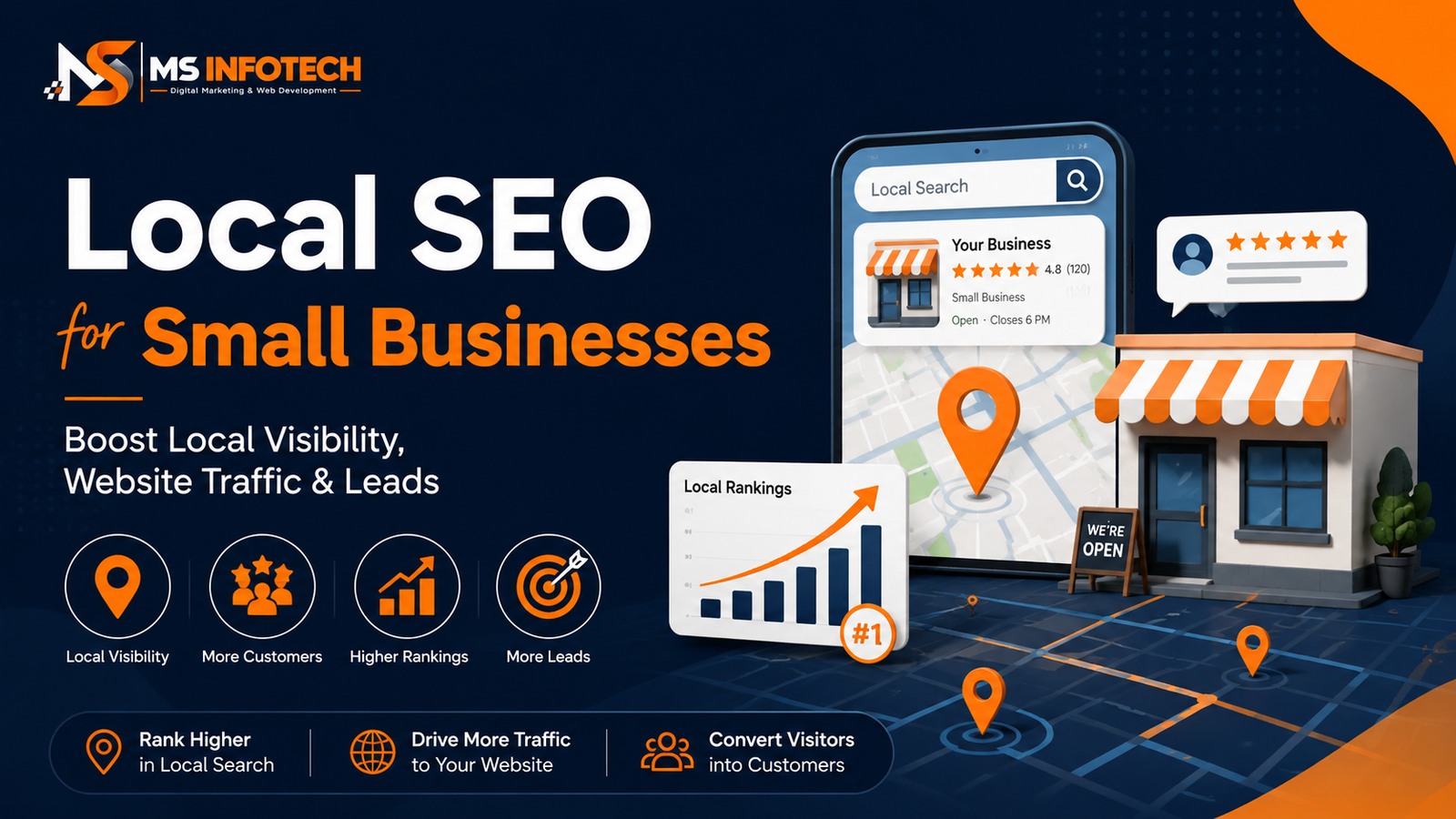
Local SEO helps your business appear when nearby customers search for products or services you offer.
Running a small business often means competing with larger companies that have bigger teams, larger advertising budgets, and stronger brand recognition. However, when customers search for a service in their area, business size is not always the deciding factor. Google usually prioritises relevance, location, reputation, and the quality of available business information.
That is where local SEO for small businesses becomes valuable.
Local SEO helps your business appear when nearby customers search for products or services you offer. Whether you run a restaurant, salon, medical clinic, repair shop, coaching institute, real estate agency, or professional service company, a strong local presence can help you attract customers who are ready to call, visit, or make an enquiry.
At MS INFOTECH, we help small businesses improve their local search visibility through practical SEO strategies designed around their market, customers, and service locations.
What Is Local SEO?
Local SEO is the process of improving a business’s online presence so that it can appear prominently in location-based searches. These searches commonly include phrases such as:
- Digital marketing company near me
- Best web development company in Jaipur
- Chartered accountant near me
- Salon in Vaishali Nagar
- Mobile repair shop nearby
- Local SEO services for small businesses
When someone performs this type of search, Google may display local businesses in Google Maps, the local map results, and the regular organic search listings.
Unlike traditional SEO, which may target visitors from an entire country or even worldwide, local SEO focuses on attracting people from a particular city, neighbourhood, or service area. This makes it especially useful for small businesses that depend on local customers.
Why Local SEO Matters for Small Businesses
Most customers do not want to spend hours looking for a nearby service provider. They generally search on Google, compare a few options, check ratings, visit websites, and contact the business that appears reliable and relevant.
If your business does not appear in those searches, potential customers may choose a competitor—even when your services are better.
A well-planned local SEO strategy can help your small business:
- Appear in relevant Google searches
- Improve visibility on Google Maps
- Generate more phone calls and enquiries
- Attract visitors to a physical location
- Build trust through reviews and accurate information
- Compete with established local companies
- Reduce dependence on paid advertising
- Reach customers with strong buying intent
Local SEO does not simply bring more website traffic. It helps bring relevant visitors who are actively looking for what your business provides.
Start with Your Google Business Profile
A properly managed Google Business Profile is one of the most important parts of local SEO. It gives potential customers essential information about your company directly in Google Search and Maps.
Your profile should include:
- Correct business name
- Primary and additional business categories
- Complete address or service area
- Current phone number
- Website URL
- Opening and closing hours
- Business description
- Products or services
- Original photographs
- Customer reviews
- Regular business updates
Avoid adding unnecessary keywords to your official business name. The name should remain consistent with your website, signboard, invoices, and other business listings.
A complete and regularly updated profile sends stronger trust signals to both Google and potential customers.
Use the Right Local Keywords
Keyword research is the foundation of a successful local SEO campaign. Instead of targeting only broad terms, small businesses should focus on phrases that reflect their services and locations.
For example, a website development company may target:
- Website development company in Jaipur
- Web designer in Jaipur
- Ecommerce website developer near me
- Local SEO company in Jaipur
- Small business website development
The best local keywords usually combine three elements:
Service + Location + Search Intent
For example:
- Plumber in Mansarovar Jaipur
- Best dentist near Malviya Nagar
- Affordable SEO services in Jaipur
- Home cleaning service near me
Keywords should be used naturally. Repeating the same phrase in every paragraph can make the content uncomfortable to read and may reduce its quality. Search engines have become better at understanding context, related terms, and user intent.
At MS INFOTECH, we select keywords by considering actual customer behaviour rather than simply choosing terms with high search volume.
Create Dedicated Location and Service Pages
A common mistake is to place every service and every target location on a single page. This makes it difficult for Google to understand which page should rank for a particular search.
Instead, create dedicated pages for important services and locations.
For example, a digital marketing company might create separate pages for:
- Search Engine Optimisation
- Google Ads Management
- Social Media Marketing
- Website Development
- Local SEO Services
If the company genuinely serves multiple locations, it can also create useful location pages. Each location page should contain original information about the services available in that area.
Do not create dozens of pages by changing only the city name. Thin or copied location pages offer little value to visitors. Every page should include relevant local details, service information, frequently asked questions, customer concerns, and a clear contact option.
Keep Your Business Information Consistent
Your business name, address, and phone number are often called NAP details. These details should remain consistent across your website, Google Business Profile, social media accounts, business directories, and other platforms.
For example, if your business is listed as “MS INFOTECH” on Google, avoid using completely different variations elsewhere unless they are officially part of the business name.
Small differences in formatting may not always cause a problem, but outdated phone numbers, incorrect addresses, or duplicate listings can confuse customers and search engines.
Review your online listings regularly and correct inaccurate information as soon as possible.
Build a Mobile-Friendly Website
Most local searches happen when people need quick answers. A customer may be searching from a mobile phone while travelling, shopping, or comparing businesses nearby.
Your website should load quickly and make important information easy to find. Visitors should not need to zoom in, navigate complicated menus, or search through several pages just to find your phone number.
A local business website should provide:
- Responsive mobile design
- Fast loading speed
- Clear service information
- Click-to-call functionality
- WhatsApp or enquiry options
- Visible address and working hours
- Simple navigation
- Secure HTTPS connection
- Clear calls to action
Website design and SEO should work together. A visually attractive website will not generate enough enquiries if it loads slowly or is difficult to use. Similarly, good rankings may not produce results if the website does not build trust.
Ask Customers for Genuine Reviews
Online reviews influence both customer decisions and local visibility. People are naturally more comfortable contacting a business that has recent, detailed, and authentic feedback.
Ask satisfied customers to leave an honest Google review. You can share a direct review link after completing a service or purchase. However, do not pressure customers or offer misleading incentives in exchange for positive reviews.
When reviews are posted, respond professionally. Thank customers for positive feedback and handle negative reviews calmly. A respectful response shows that your business values its customers and is willing to resolve concerns.
A steady flow of genuine reviews is usually more convincing than receiving many reviews within a very short period.
Publish Useful Local Content
Blog content can support local SEO when it answers real customer questions. Instead of writing only promotional articles, focus on the concerns people have before choosing a service.
A home repair business might publish articles about common maintenance problems. A local accountant could explain GST registration, income tax filing, or business compliance. A digital marketing agency could write about local SEO, website design, and online advertising for nearby businesses.
Useful local content can include:
- Answers to frequently asked questions
- Service comparison guides
- Local market insights
- Pricing and process explanations
- Customer success stories
- Seasonal advice
- Area-specific service information
Good content should help readers make an informed decision. When visitors find clear and useful answers on your website, they are more likely to trust your company.
Earn Relevant Local Links
Backlinks are links from other websites to your website. They can help search engines understand the reputation and relevance of your business.
Small businesses do not always need hundreds of backlinks. A smaller number of relevant, trustworthy links may be more valuable.
Potential local link opportunities include:
- Local business associations
- Industry directories
- Suppliers and business partners
- Community organisations
- Local publications
- Event websites
- Professional membership websites
Avoid purchasing large quantities of low-quality links. Such links may offer no lasting benefit and can create unnecessary SEO risks.
Use Local Business Schema Markup
Schema markup is structured information added to a website’s code. It helps search engines understand important business details such as your address, phone number, business category, opening hours, and service area.
Local business schema does not guarantee higher rankings, but it can improve the clarity of information provided to search engines. It should match the visible details on your website and Google Business Profile.
Technical improvements like schema markup, page speed optimisation, clean URLs, canonical tags, and correct heading structure help build a stronger SEO foundation.
Track Calls, Enquiries, and Rankings
Local SEO should be measured by business outcomes rather than rankings alone. Ranking first for an irrelevant keyword has little value if it does not generate enquiries.
Useful performance indicators include:
- Calls from Google Business Profile
- Website contact form submissions
- WhatsApp enquiries
- Direction requests
- Local keyword rankings
- Website visitors from target locations
- Conversion rates
- Most visited service pages
Tracking these results helps identify which pages and keywords are generating genuine business opportunities.
Common Local SEO Mistakes to Avoid
Small businesses sometimes expect immediate results and make rushed decisions. Local SEO generally improves over time as Google gathers stronger information about your business.
Avoid these common mistakes:
- Using an incorrect Google Business category
- Adding keywords unnaturally to the business name
- Publishing duplicate location pages
- Buying fake reviews
- Ignoring negative customer feedback
- Using different contact details across platforms
- Leaving business information outdated
- Creating low-quality content only for rankings
- Ignoring mobile users
- Expecting permanent results without regular updates
Local SEO requires consistency. Your profile, website, reviews, content, and business listings should all communicate accurate information.
How MS INFOTECH Helps Small Businesses Grow Locally
Every small business has a different audience, location, level of competition, and business goal. A local SEO strategy should reflect those differences.
MS INFOTECH provides local SEO and digital marketing solutions for businesses that want to improve their online presence and generate meaningful enquiries. Our approach may include:
- Local keyword research
- Google Business Profile optimisation
- Website SEO audit
- On-page optimisation
- Service and location page planning
- Technical SEO improvements
- Local citation management
- Content strategy
- Review guidance
- Search performance tracking
We focus on creating a practical strategy that supports long-term visibility rather than relying on shortcuts.
Final Thoughts
Local SEO gives small businesses an opportunity to reach customers exactly when they are searching for a nearby solution. A complete Google Business Profile, accurate contact information, helpful website content, genuine customer reviews, and a mobile-friendly website can make a meaningful difference.
The strongest results come from treating local SEO as an ongoing part of business growth. Information needs to remain accurate, reviews should be managed, content should be updated, and performance should be monitored regularly.
If you want your business to appear more prominently in local search results, MS INFOTECH can help you build a reliable and results-focused local SEO strategy.
Contact MS INFOTECH today to discuss how local SEO can help your small business attract more nearby customers and generate better-quality enquiries.